Jacquard Plush Fabric
Wholesale, Manufacturer-Direct
Plush with the pattern built into the pile itself instead of printed on top: 290-310 gsm, 160-170 cm wide, 100% polyester. Because the pattern lives in the body of the pile, it cannot fade, rub off or crack in the wash. From 50 kg per color, produced in Zeytinburnu, Istanbul.


What is jacquard plush fabric?
Jacquard plush is a plush fabric whose pattern is built into the pile itself rather than printed onto the surface afterwards. The motif is created either by swapping two differently coloured pile yarns during knitting, or by varying the pile height across the design. Because of this the pattern is part of the fabric's structure, not a layer on top of it: it will not fade in the wash, will not rub off, and will not wear away in use. Our standard quality is 290-310 gsm, 160-170 cm wide, 100% polyester, with a minimum order of 50 kg per colour on stock patterns.
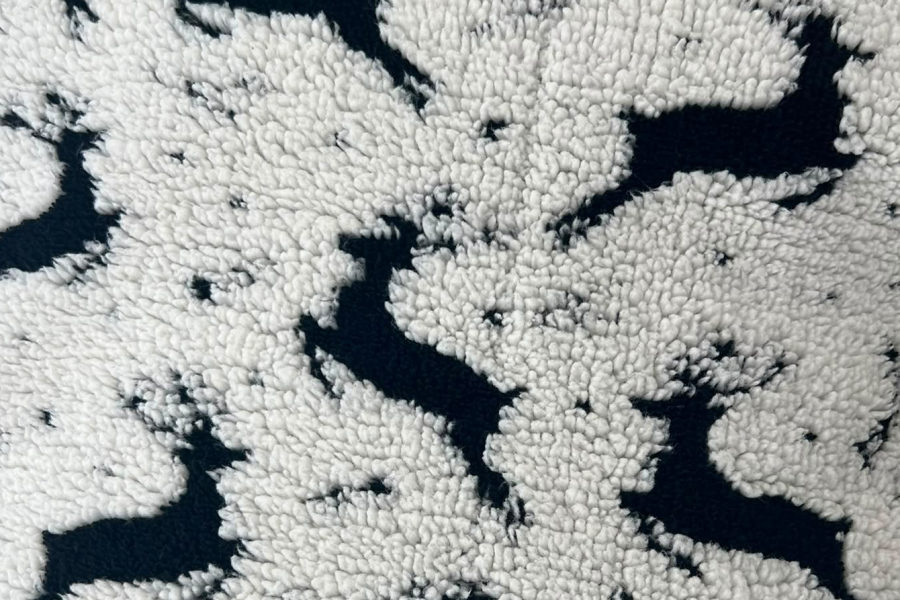
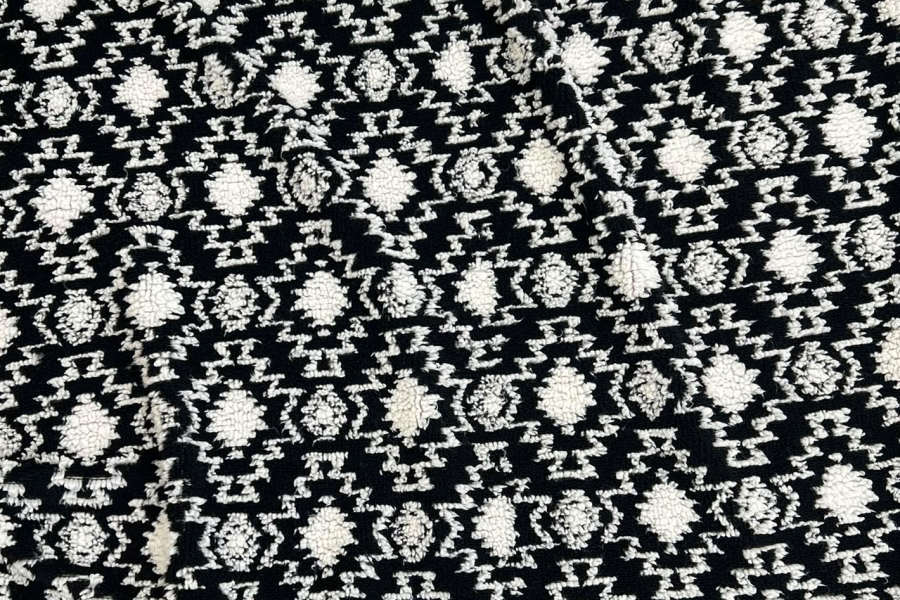
How the pattern is formed inside the pile
Jacquard plush is produced on a circular knitting machine. Every needle can be programmed individually to decide which pile yarn it picks up and when — that is precisely what the jacquard mechanism does. Two methods are used:
1. Two-colour pile placement. Two pile yarns in different colours are fed to the machine. Wherever the design calls for it the first colour comes to the face and the second passes to the back; in the next area the roles reverse. The deer and geometric designs we produce are made this way. The number of colours is limited by how many yarns can be fed — in practice two, at a push three.
2. Pile-height variation. A single colour is used but the length of the pile is changed by area. The pattern reads through relief and shadow rather than colour, which suits tone-on-tone collections.
In both methods the pattern is created at the knitting stage, before dyeing and finishing. With printing the fabric is made first and colour is transferred onto its surface afterwards. Every practical difference between the two follows from that.
Jacquard plush technical data
| Property | Value |
|---|---|
| Weight | 290-310 gsm |
| Width | 160-170 cm |
| Composition | 100% polyester |
| Construction | Double face — pile on the front, flat fleece on the back |
| Pattern method | Two-colour pile placement or pile-height variation |
| Colours per design | 2-3 |
| Stock pattern MOQ | 50 kg per colour |
| Custom jacquard MOQ | 100 kg |
| Custom design lead time | 20-25 working days (includes machine set-up) |
| Stock colour dispatch | 2-5 working days |
| Pantone / RAL colour | 10-15 working days |
| Certifications | OEKO-TEX Standard 100 Class I |
| EU delivery | 3-7 days with an A.TR certificate |
Jacquard or print — which should you choose?
The two methods are right for different jobs; neither is simply better.
| Criterion | Jacquard (pattern in the knit) | Print (pattern on the surface) |
|---|---|---|
| Where the pattern sits | Within the pile structure | On top of the pile |
| Hand feel | Raised, you can feel it | Flat |
| Wash durability | Does not fade or shed | Softens and fades over time |
| Abrasion resistance | Does not wear away | Opens up at cuffs and elbows |
| Number of colours | Limited (2-3) | Unlimited |
| Design freedom | Geometric and stylised motifs | Anything, including photographs |
| Minimum order | 100 kg (custom design) | 50 kg |
| Lead time | 20-25 working days | 7-10 working days |
| Sampling cost | High (machine set-up) | Low |
| Suitability for small runs | Low | High |
Jacquard plush vs jacquard welsoft vs sherpa
All three belong to the pile polyester family and are routinely confused. The difference is in the length and density of the pile.
Jacquard plush has a long, open pile — your fingers sink into it. It runs at 290-310 gsm and carries bold motifs well: deer, ethnic patterns, large geometric forms. It is used for blankets, winter jacket linings and home textiles.
Jacquard welsoft has a short, dense pile, produced at 240-250 gsm and 180 cm wide. Because the pile is short the pattern comes out finer and sharper, so stripes, checks and small geometric repeats work better on it. It is preferred for pyjamas, robes and baby products.
Sherpa has a curly, lambswool-like pile and is normally produced plain. A jacquard pattern is technically difficult on sherpa because the curled structure breaks up the motif. If a pattern is required on sherpa, printing is the route.
The three fabrics side by side
| Jacquard plush | Jacquard welsoft | Sherpa | |
|---|---|---|---|
| Weight | 290-310 gsm | 240-250 gsm | 290-310 gsm |
| Width | 160-170 cm | 180 cm | 160-170 cm |
| Pile character | Long, open | Short, dense | Curled, lambswool-like |
| Pattern resolution | Bold motifs | Fine and sharp | Jacquard not suitable |
| Typical use | Blankets, jacket linings | Pyjamas, baby, robes | Linings, collars, jacket interiors |
| Pattern method | Jacquard | Jacquard |
Three limits to know before you design
Colour count. In a jacquard design every colour means a separate pile yarn. Two colours is standard; three is assessed against the machine and the design. A design that needs four or more colours cannot be produced as jacquard — that design belongs in digital print.
Repeat size. The pattern repeats over a fixed width and length. The repeat width depends on the needle count of the machine and cannot be enlarged arbitrarily. Tell us your target repeat when you send artwork and we will adapt it to the nearest producible size.
Motif fineness. Because the pile is long, very thin lines and small details disappear into it. The working rule is that the thinnest line should be at least 8-10 mm. Designs needing finer detail give better results on jacquard welsoft or in print.
If you do not have artwork you can choose from our stock pattern archive or build your own through the Pattern Studio.
Where jacquard plush is used
Stock pattern or a design of your own?
A stock pattern means choosing from our archive. The design is already set up on the machine, so it runs from a minimum of 50 kg per colour and stock colours ship in 2-5 working days. This is the right route for a first collection or a small test run.
A custom design means your artwork is set up on the machine. Set-up is costly, so it requires a minimum of 100 kg and a lead time of 20-25 working days. In return the pattern is yours and is not produced for anyone else.
In both cases we send a free sample before production. On custom designs we also share a photograph of the first metres off the machine for your approval — so you see the pattern before 100 kg is committed.
Stock pattern vs custom design
| Stock pattern | Custom design | |
|---|---|---|
| Minimum order | 50 kg per colour | 100 kg |
| Lead time | 2-5 working days (stock colours) | 20-25 working days |
| Set-up cost | None | Yes, included in the quotation |
| Exclusivity | No | Yes |
| Sampling | Free | Free + pre-production approval photo |
| Colour choice | Stock colours or Pantone (10-15 working days) | Pantone / RAL |
Quality control and care
There are three measurements worth asking for. Dimensional stability: shrinkage after washing should stay within 3-5%. Pilling grade: expect 4-5 on fabric with an anti-pilling finish; this figure tells you whether the pile will shed in use. Colour fastness: washing, rubbing and light fastness are measured separately — on a jacquard the colours sit side by side, so rubbing fastness matters especially: if it is low the dark colour migrates onto the light ground. We provide these reports on request.
Care: wash at 30 °C, inside out, on a low spin. Do not use fabric softener — it mats the pile and removes the loft the fabric was bought for. Do not tumble dry hot; heat flattens the pile permanently. Ironing is not needed, and if unavoidable only on the flat reverse at low heat.
Jacquard plush terminology
Frequently asked questions
Get a jacquard plush quote
Pattern knitted into the pile, 290-310 gsm, 160-170 cm wide. From 50 kg per color, with a free physical sample. Message us on WhatsApp.