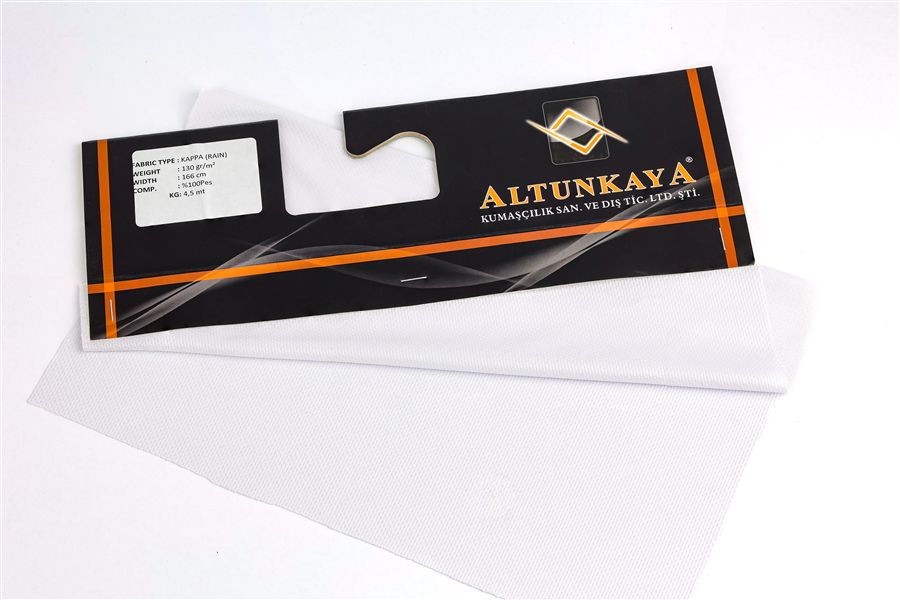
Kappa fabric is a 100% polyester knit with small, regularly spaced embossed dots across its face. Those dots resemble raindrops, which is why the Turkish market also calls it yağmur desen — raindrop texture. Its main application is sports kit: match jerseys, training tees and team tops.
What are the technical specifications?
- Composition: 100% polyester
- Weight: 135 g/m²
- Width: 166 cm
- Surface: embossed raindrop texture, matte appearance
- Stock colours: 11 (see colour card)
- Minimum order: 50 kg per colour
Why is it the default choice for sports kits?
Three things decide fabric selection in sportswear: weight, print compatibility and surface appearance. Kappa answers all three, which is why it became a standard in kit production.
At 135 g/m² it sits in the middle of the usual jersey range of 130-150 g/m². Lighter fabrics go translucent under a print; heavier ones are felt by the athlete. The embossed face makes two practical differences against a flat knit: it scatters light, giving a matte finish, and it visually breaks up the crease marks that stand out on smooth surfaces.
Why does sublimation printing work on this fabric?
The real advantage of this fabric in kit manufacturing is that it is built for digital printing. Being 100% polyester, it works with dye sublimation.
In sublimation the dye turns to gas under heat, penetrates the polyester fibre and solidifies inside it. The result is not a layer of ink sitting on the cloth but colour that has become part of the fibre. The printed area therefore does not stiffen, crack or restrict stretch — decisive on a garment that moves constantly. The same route is closed on cotton, where sublimation dyes will not bond to cellulose fibre.
In practice this means club crests, player numbers, sponsor marks and all-over graphics can be printed in a single pass with no screen or tooling cost. On short runs and personalised kit orders that is a clear cost advantage over screen printing.
What does the 166 cm width buy you?
Width feeds straight into cutting waste. At 166 cm, jersey bodies and sleeves nest more efficiently in the marker. Compared with 150-155 cm alternatives you consume fewer metres for the same garment count — on a 50 kg lot the difference shows up on the cutting table.
How do the colour card and ordering work?
Kappa is held in 11 stock colours. The card includes high-visibility shades such as neon yellow and orange, used for training bibs and high-contrast kit designs. You can download the colour card free as a high-resolution image or a print-ready PDF from our e-catalogue.
Minimum order is 50 kg per colour. For any shade not on the card we dye to your Pantone reference. Message us on WhatsApp for a swatch or a quotation.
Frequently Asked Questions
Are Kappa fabric and raindrop texture fabric the same thing?
Yes. The same quality is sold under two names in the Turkish market: 'raindrop texture' (yağmur desen) after the small embossed dots on its face, and 'Kappa' at some knitting mills. When ordering, either name describes the same fabric — quoting the weight (135 g/m²) and width (166 cm) removes any ambiguity.
Can you sublimation print on Kappa fabric?
Yes. Because the fabric is 100% polyester, it is a proper substrate for dye-sublimation printing. The dye turns to gas under heat, penetrates the polyester fibre and solidifies inside it, so the print leaves no layer on the surface and the fabric keeps its stretch and handle. The same process does not work on cotton.
Is 135 g/m² heavy enough for a sports jersey?
130-150 g/m² is the standard range for match jerseys, training tees and team tops. At 135 g/m² the fabric is light enough not to weigh on the athlete, yet dense enough to carry a print without showing through.
How wide is Kappa fabric?
166 cm. This width lets jersey body and sleeve pieces nest more efficiently in the marker than 150-155 cm goods, so you consume fewer metres for the same number of garments.
What is the minimum order quantity?
50 kg per colour. Beyond the 11 stock colours on the colour card we also dye to your Pantone reference; lead time and minimums for custom colours depend on how many shades you need.