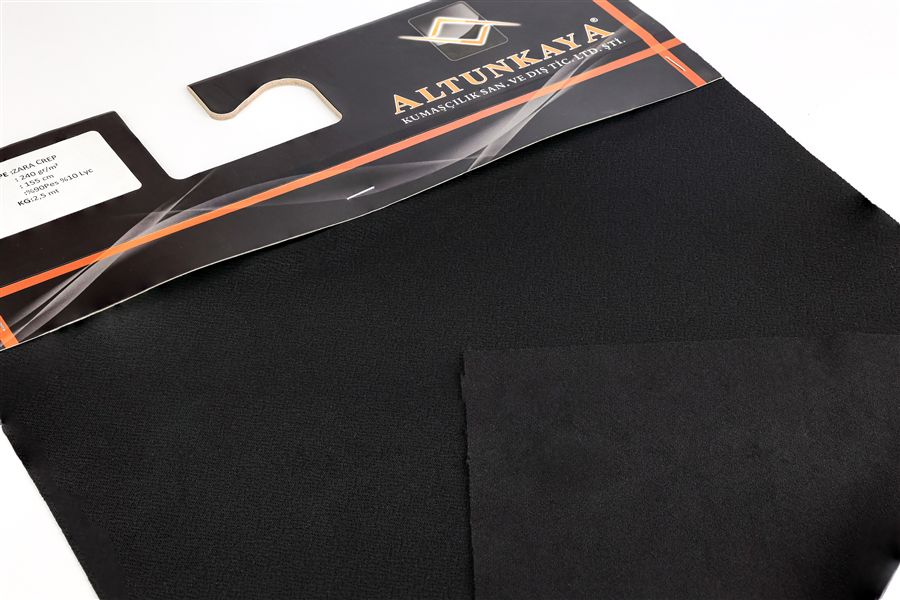
A summer hijab fabric has to do four things at once: stay cool, stay put, stay matte, and stay opaque. That combination rules out most of what looks appealing on a roll — polyester satin is cool to the touch but slides constantly and reflects light, while heavy jersey stays put but traps heat. The fabrics that work in practice are lightweight crepe knits and viscose blends in the 230–270 g/m² range.
What does “breathable” really mean for hijab fabric?
Breathability is not only about fibre. A knit with an open, textured structure moves air even in polyester, while a dense flat knit in cotton can feel hot. For a garment worn against the head and neck in summer heat, the surface texture matters as much as the composition: a crepe texture lifts the fabric slightly off the skin, and that air gap is what you actually feel.
Which four fabrics are the candidates?
| Fabric | GSM | Composition | Grip | Best for |
|---|---|---|---|---|
| Crepe knit (Zara Crep) | 230–240 | Polyester | Good | Everyday wear; holds a wrap without pins |
| Mira | 230–240 | Polyester | Good | Soft drape, quiet matte finish |
| Oshyo | 260–270 | Viscose-polyester | Very good | Hottest days; viscose content improves moisture handling |
| Light jersey | 150–180 | 100% cotton | Moderate | Casual, very light, but check opacity |
Why does grip matter more than anything?
A hijab that slips gets adjusted twenty times a day, and that is the single most common complaint about summer fabrics. Grip comes from surface texture. Crepe has a fine irregular texture that holds against itself and against hair; satin has none. If you are choosing between two otherwise similar fabrics, run one over the other — the one that resists sliding is the one that will be worn.
Why check opacity first?
Lightweight and opaque pull against each other. Test it properly: hold a single layer over printed text in daylight, not against a lamp. If you can read the text, the fabric will need doubling in the finished garment, which cancels out the weight advantage you bought it for. Light and mid-tone colours are usually the problem, not dark ones.
What should you avoid in summer?
- Polyester satin — slippery, shiny, and it holds heat against the skin.
- Heavy interlock above 280 g/m² — stable and opaque, but too warm.
- Loose open weaves — breathable but rarely opaque enough on their own.
- Anything with a stiff finish — it will not hold a soft wrap.
How do you wash it without losing the drape?
Wash at 30 °C on a gentle cycle and skip the tumble dryer — heat is what flattens crepe texture and takes the grip out of the fabric. Hang to dry and, if pressing is needed at all, use a low iron with a cloth. A crepe that has been dried hot never fully recovers its surface.
How do you buy it wholesale?
Crepe knits, Mira and Oshyo are all supplied from stock at a 50 kg minimum per colour with 2–5 business day delivery from Istanbul. For modest-fashion production more broadly — abayas, scuba-based structured pieces, modest swimwear — the same crepe and scuba families cover most of the range. Sample lengths are available before bulk commitment.